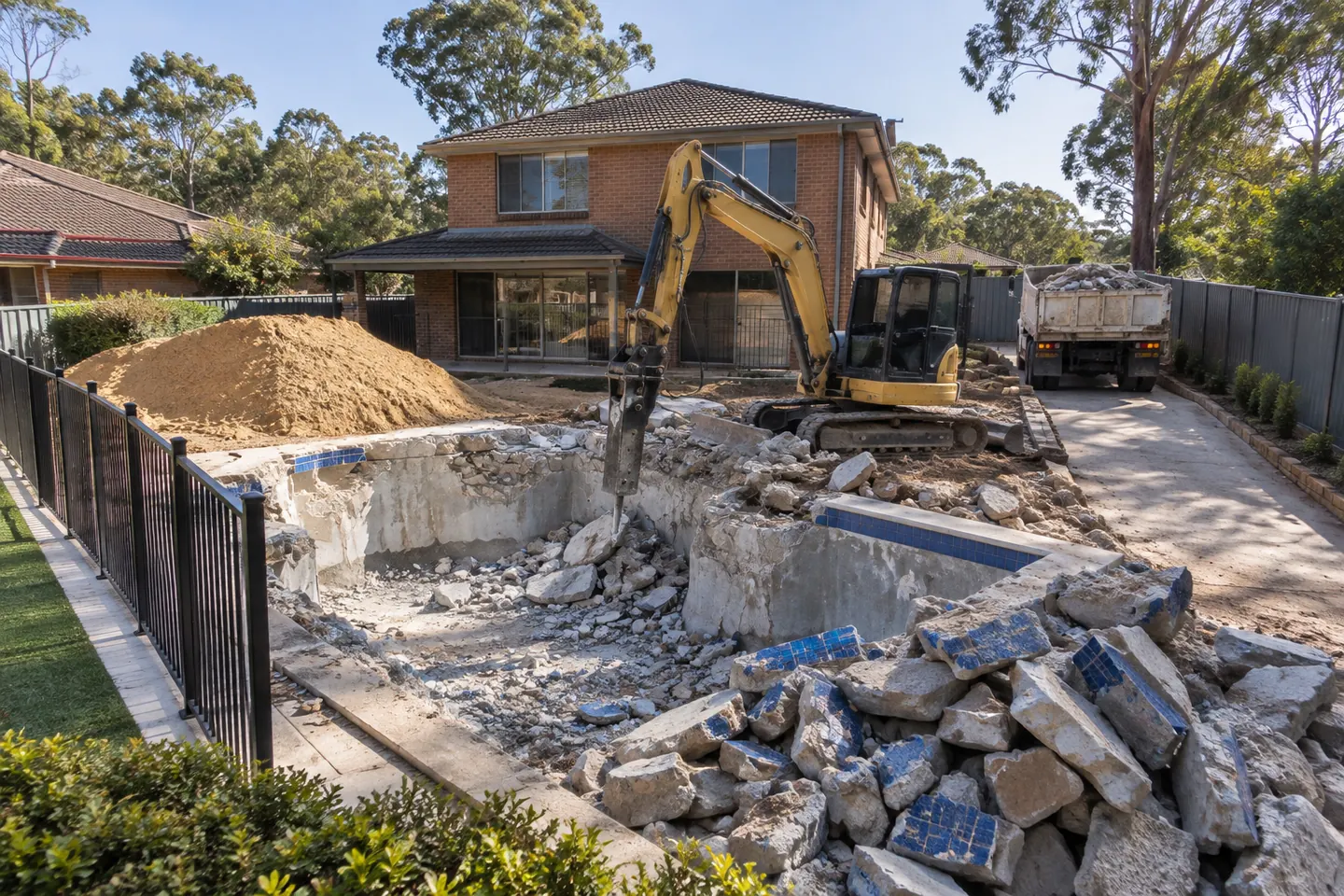
Why concrete pools are hard work
Concrete pools in Sydney were built as gunite or shotcrete shells sprayed over steel reinforcement, or as poured concrete. They are strong by design. A shell can be well over 150mm thick in places, with steel throughout, tiles at the waterline and coping bedded on top.
That makes them heavy, slow to break and expensive to cart.
The process
1. Drain. The pool is emptied in line with council and water authority requirements — not onto the neighbour's yard or into the street stormwater if that is not allowed.
2. Surrounds and equipment. Coping, pavers, decks, fencing where approved, and pool equipment removed and disconnected by licensed trades.
3. Break. A hydraulic hammer on an excavator breaks the shell. On tight sites, smaller machines or handheld breakers are used.
4. Remove or fill.
- Full removal — all concrete and steel out, loaded and carted.
- Fill-in — floor broken for drainage, top of walls taken down below finished ground, broken material placed in the bottom where appropriate, and the shell filled.
5. Backfill and compact. Clean fill placed in layers and compacted. What goes on top — lawn, pavers, a slab — decides the fill and compaction standard.
6. Finish. Topsoil and levels for turf or landscaping, or a compacted pad for the next build.
Access
| Access | Typical method |
|---|---|
| Driveway to backyard, 2.5m+ | 5-tonne excavator, tipper reverses in |
| Side path 1.2–2.5m | Mini excavator, dingo loaders, smaller loads |
| Side path under 1.2m | Handheld breaking, conveyors, barrows |
| Rear lane | Often the best option in the Inner West and Eastern Suburbs |
| No access | Crane lift or through-house protection — priced individually |
Rock, slope and retaining walls
On sandstone and sloping blocks, pools are often cut into rock or held up by retaining walls. Removing the pool can affect the stability of what holds it in. Retaining walls are assessed before work, and engineering advice is sought where needed.
Tiles and asbestos
Most pool tiles and shells are not asbestos concerns, but older pool surrounds, sheds, fencing and filter housings on pre-1990 properties can contain asbestos cement. Anything suspect is tested, and any asbestos is removed by a separately licensed asbestos removalist.
Full or fill-in?
Compare them properly: full removal versus pool fill-in.
Costs
Concrete fill-ins commonly run $9,000–$20,000; full removal $14,000–$35,000+. See the 2026 cost bands.
Call 02 6422 4202 or send your pool details through.
Two ways to get rid of a pool
Full removal
Shell out, compacted backfill. Costs more. Keeps building options open and leaves nothing buried.
Fill-in
Floor broken, walls cut down, shell filled. Costs less. Best for lawn and garden only.
Questions people ask before they commit
How is a concrete pool removed?
The pool is drained, the coping and surrounds are lifted, and the shell is broken up with a hydraulic hammer on an excavator. For full removal all the concrete and steel is carted away; for a fill-in the floor is broken for drainage, the upper walls removed and the remainder filled. Clean fill is then placed and compacted in layers.
How much concrete comes out of a pool?
A typical suburban concrete pool can produce many tonnes of broken concrete and steel, depending on its size and shell thickness. That volume is why full removal costs more than a fill-in — carting and disposal are a large part of the price.
What if the pool is surrounded by rock?
Pools cut into sandstone, common on the Northern Beaches, North Shore and parts of the Sutherland Shire, can be slower to remove and may need rock left in place or broken separately. The inspection establishes this before pricing.
Is the concrete recycled?
Clean broken concrete is commonly recycled into road base and aggregate. Separating it from tiles, soil and other waste helps keep disposal cost down.