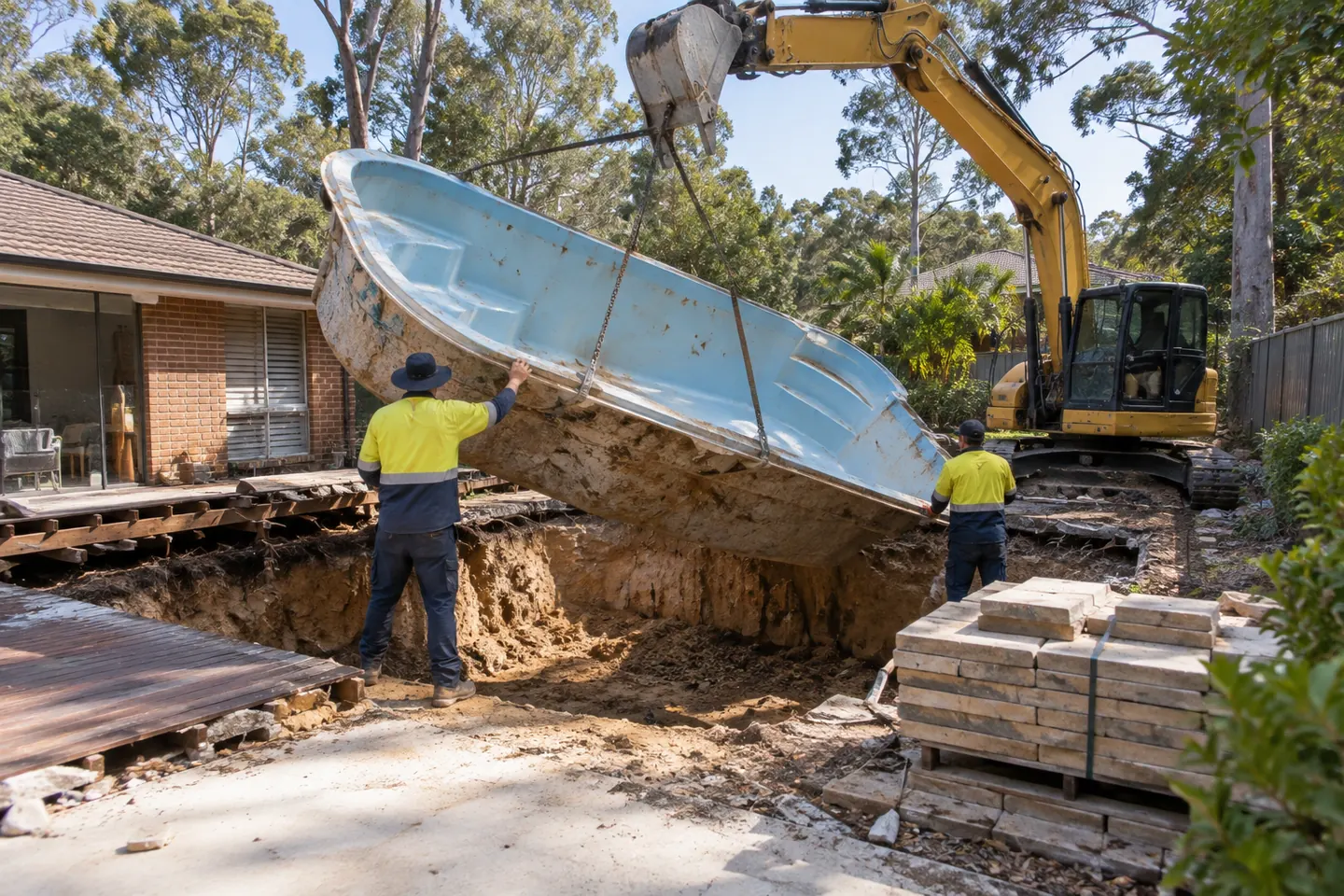
How fibreglass pools come out
Fibreglass pools are one-piece shells dropped into an excavated hole on a bed of sand or crushed rock, usually with a concrete collar around the top. That construction dictates the removal.
1. Drain the pool in line with local requirements.
2. Remove surrounds — coping, pavers, the concrete collar or bond beam, and any decking.
3. Disconnect equipment — pumps, filters, heaters and plumbing, by licensed trades where required.
4. Cut or lift. Where access allows, the shell may be lifted out whole by an excavator. More often in Sydney backyards, it is cut into sections and carried out.
5. Clear the hole — bedding material, collar concrete and plumbing.
6. Backfill and compact in layers to suit the future use.
7. Reinstate — topsoil and levels for lawn, or a compacted base for paving or a slab.
Why it is usually quicker
- No hammering through reinforced concrete.
- Lighter loads, fewer truck trips.
- Sections can go through tighter access than broken concrete in some cases.
Why it still needs care
Settlement. The hole is as deep as the pool. Poor backfill sinks.
Groundwater. Some fibreglass pools were installed where groundwater sits high. Removing the weight of water and shell can matter in those conditions, which is why pools are not left empty for long before removal.
Collars. The concrete bond beam around the top can be substantial.
Access. Lifting a whole shell needs room for the machine to reach and swing.
Full removal is the default
With fibreglass, full removal is usually the sensible choice because the extra cost over a fill-in is small and a buried shell can hold water and cause problems. See full removal.
Where they are common
Fibreglass pools were popular from the 1980s onward, and are common across the Hills District, Western Sydney, South-West Sydney and the Sutherland Shire.
Costs
See the 2026 cost bands.
Call 02 6422 4202 or send your pool details through.
Two ways to get rid of a pool
Full removal
Shell out, compacted backfill. Costs more. Keeps building options open and leaves nothing buried.
Fill-in
Floor broken, walls cut down, shell filled. Costs less. Best for lawn and garden only.
Questions people ask before they commit
Is fibreglass pool removal cheaper than concrete?
Usually. Fibreglass shells are much lighter and can be cut up or lifted out rather than broken with a hammer, which reduces machine time and disposal weight. As a 2026 guide, fibreglass removal in Sydney commonly runs $7,000 to $16,000 depending on size, access and fill.
Can the fibreglass shell be reused?
Rarely. Shells are usually damaged by age, UV, osmosis or the removal itself, and reinstalling a second-hand shell raises structural and warranty questions. Most are cut up and disposed of.
What is under a fibreglass pool?
Typically a bed of sand or crushed rock, sometimes a concrete collar or bond beam around the top, and plumbing lines. All of it is dealt with during removal, and the hole is backfilled and compacted.
Can you fill in a fibreglass pool instead?
It is possible but less common than with concrete, because removing the shell is usually quick. A shell left in the ground can trap water and cause settlement, so full removal is generally recommended.